
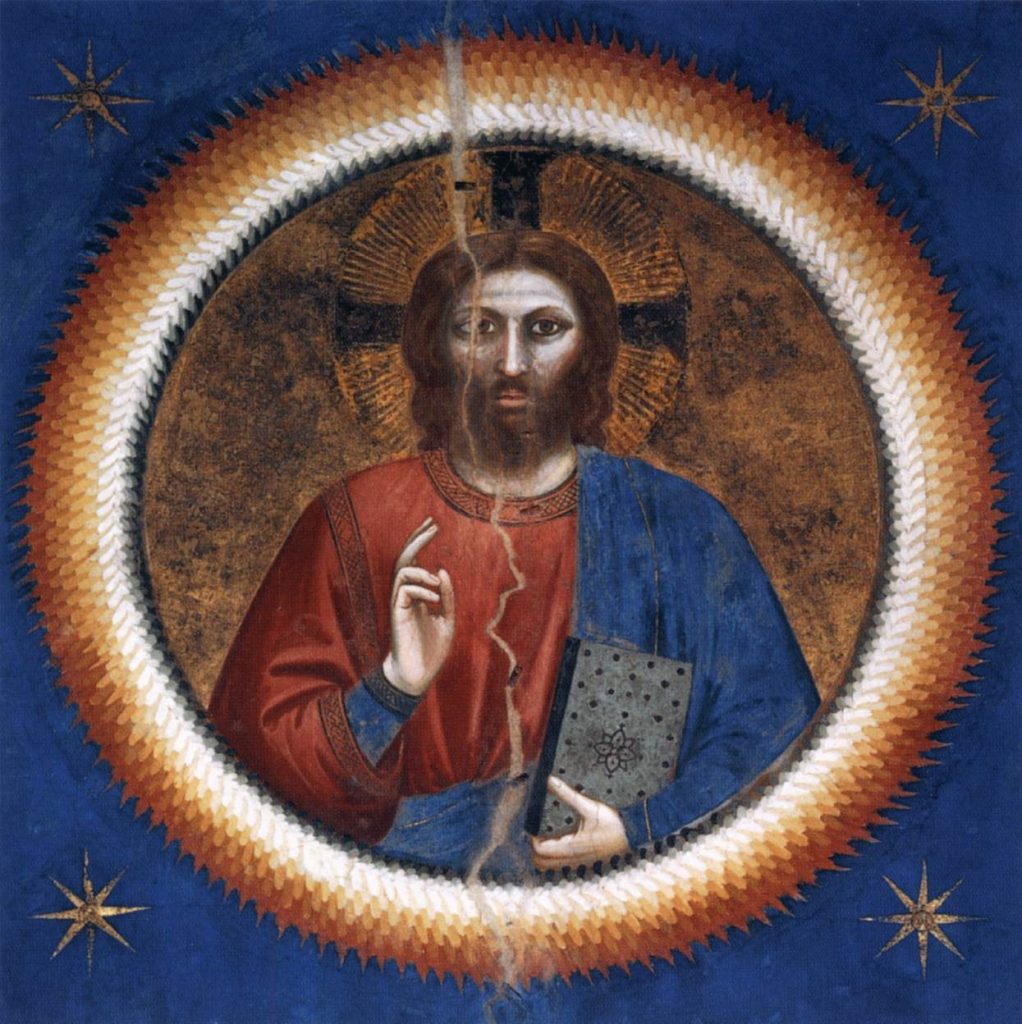
Trading card #001/100 · Tradition: Christianity · Region: Galilee and Judaea, first century CE
← Back to the World’s Spiritual Masters album · Leggi la monografia in italiano
Why Jesus opens the collection
How far can an ethical and spiritual teaching travel across two millennia? The movement associated with Jesus of Nazareth, a Jewish teacher in first-century Roman Palestine, grew into Christianity, a worldwide family of traditions. Pew Research Center estimates that around 2.3 billion people identified as Christian in 2020. This figure is not a count of people Jesus personally taught, nor evidence that all Christians understand him in the same way. It is an estimate of the population of the religious tradition in which he is central.
1. The historical teacher
Most historians place Jesus within the Jewish society of Galilee and Judaea under Roman rule. He was probably born during the last years before the Common Era and died by crucifixion around 30 CE. The central narrative sources are the Gospels, composed decades after his lifetime, alongside early Christian letters. We have no surviving writings by Jesus himself. A responsible biography must therefore distinguish historical reconstruction, early community memory, and theological confession.
Jesus appears in these sources as a teacher who uses parables, short sayings, sharp questions, and encounters with ordinary people. His language of the kingdom of God, his engagement with Jewish scripture, and his disagreements about religious practice belong to the world of Second Temple Judaism. Reading him as though he were a modern self-help author would erase the beliefs, risks, and expectations that gave his words meaning.
2. Four major strands of teaching
Compassion becomes action
The parable of the Good Samaritan (Luke 10:25–37) is not simply an instruction to feel kindly toward others. A traveler notices a wounded stranger, interrupts his journey, and provides practical care. The question changes: instead of asking who qualifies as one’s neighbor, the listener must decide whether to become a neighbor through action. Compassion acquires a cost, a schedule, and a responsibility.
Human worth beyond status
The Beatitudes in the Sermon on the Mount (Matthew 5–7) address the poor in spirit, the meek, those who mourn, those who hunger for justice, and the persecuted. These passages are theological proclamations, not a statistical prediction that suffering produces happiness. Yet their reversal of status continues to challenge cultures in which prestige is mistaken for moral worth.
Breaking cycles of retaliation
Jesus’ call to love one’s enemies challenges the seemingly natural assumption that hostility must be answered with hostility. This does not require a vulnerable person to remain in an abusive relationship or abandon necessary boundaries. It asks whether people can resist reproducing the injury they suffered while still pursuing safety and justice.
Integrity without applause
The Sermon on the Mount criticizes religious display, hypocrisy, and the desire to be admired. Goodness is not measured solely by the visibility of an act. The reader is invited to investigate motives: would the same generous act happen if nobody could applaud or reward it? This makes Jesus’ teaching an enduring challenge to public performance and private inconsistency.
3. Historical inquiry and religious belief
Most Christian denominations confess Jesus as the Christ and Son of God, crucified and risen. The resurrection is a foundational claim of Christian faith; it is not established by the same historical methods used to assess the circumstances of a Roman execution. Islam also honors Jesus—ʿĪsā—as a prophet, while rejecting his divinity. Recognizing these distinctions is essential to a respectful educational project spanning different spiritual traditions.
4. Global influence is a collective history
The geographical expansion of Christianity cannot be credited to Jesus’ personal contacts alone. It involved his earliest followers, urban communities in the Roman Empire, monastic movements, missionaries, translations, political power, migration, and at times colonial domination. The traditions produced by this history are far from uniform: Catholic, Orthodox, Protestant, and other Christian communities differ on doctrine, authority, worship, and ethics. Numbers should not flatten that diversity.
5. Three practical experiments
- Notice someone overlooked: offer practical help without making it a public performance.
- Interrupt retaliation: in a conflict, choose a response that protects boundaries without escalating hostility.
- Practice consistency: make a modest ethical promise, keep it, and evaluate the action rather than the applause.
6. An APPO Method reading
A — Aspiration: become more compassionate and consistent. P — Problem: identify indifference, anger, and the need for recognition. P — Project: run a seven-day experiment involving one act of care and one deliberately calmer response each day. O — Opportunity: observe whether relationships, decisions, and self-understanding improve. This is a modern educational exercise inspired by a reading of Jesus’ ethics; it is not a replacement for Christian theology.
7. Sources and further reading
- Pew Research Center (2025), Global Religious Landscape – demographic context.
- Encyclopaedia Britannica, Jesus – biographical context.
- Oxford Academic (2026), Jesus of Nazareth – historical scholarship.
- Matthew 5–7 and Luke 10:25–37 – primary texts.
Editorial note: placement at #001 concerns approximate global religious reach, not the spiritual worth of a person or a religion. The series aims for historical care and interfaith respect.