
Sticker 008 · Linus Torvalds · Back to the album card · Leggi in italiano
Linux and Git solve different problems. Linux coordinates running programs and their access to a machine’s resources. Git records the history of files and lets several people work on the same project. Linus Torvalds started both. The early designs help explain why the projects outgrew their original settings and became useful to so many contributors.
Linux, from a 1991 project to a community effort
On 25 August 1991 Torvalds described the system he was building for 386 and 486 computers on comp.os.minix. The original announcement shows how he introduced the project to its first readers. The source code for early versions survives in the kernel.org historical archive.
The kernel is the part of an operating system that manages resources such as memory and processing time. When two applications run together, it schedules CPU time and mediates requests to use the hardware. A system people can use every day also needs user programs and other components. Tools from the GNU project and the communities that build distributions played an essential role.
The January 1992 notes for version 0.12 record the move to the GPL and the removal of an earlier restriction on distributing Linux for money. The kernel’s licensing documentation identifies GPL version 2 as the overall licence, with a syscall note and individual file notices. Torvalds started the kernel. Drivers, support for new architectures and much of its maintenance are collective work.
Why Torvalds created Git in 2005
In 2005 the Linux project needed a new way to manage versions of its source code. The project’s short history of Git describes the move from BitKeeper and the goals for the replacement: speed, distributed work and support for many parallel branches. Git’s first preserved commit dates to 7 April 2005 and credits Torvalds. Git is the version control program. GitHub, which hosts a copy of the repository, is a service that uses it.
How Git connects files, directories and history
Git represents file content with objects called blobs. A tree records directory entries, their names and references to contents or subdirectories. A commit records a project state and generally links to one or more earlier commits. Two people can start from the same state, make changes independently and compare or integrate their work later. The Git book’s chapter on objects shows how those pieces fit together.
An original line from early Git
This line appears in the initial commit and also in write-tree.c at revision 075b845, dated 11 April 2005. That file credits Linus Torvalds. The same revision contains the COPYING file specifying GNU GPL version 2.
memcpy(buffer+i, "tree ", 5);The five copied bytes are the letters in tree followed by a space. They start the header that identifies the type of object. The surrounding code also deals with the length and contents. This unchanged historical excerpt lets you see the format being built.
Copyright © 2005 Linus Torvalds. The historical source is distributed without warranty under GPL version 2. Full licence text and notices.
The legacy: making distributed work practical
A kernel and a version control system depend on people changing and maintaining them together. Torvalds’s individual contribution was to start both projects and make early design choices. Maintainers, distribution teams, developers, testers and writers helped build the wider ecosystem. There is a practical lesson for anyone starting a project: think about how somebody else will understand, check and incorporate a change. The GNU project’s account of the early free operating system.
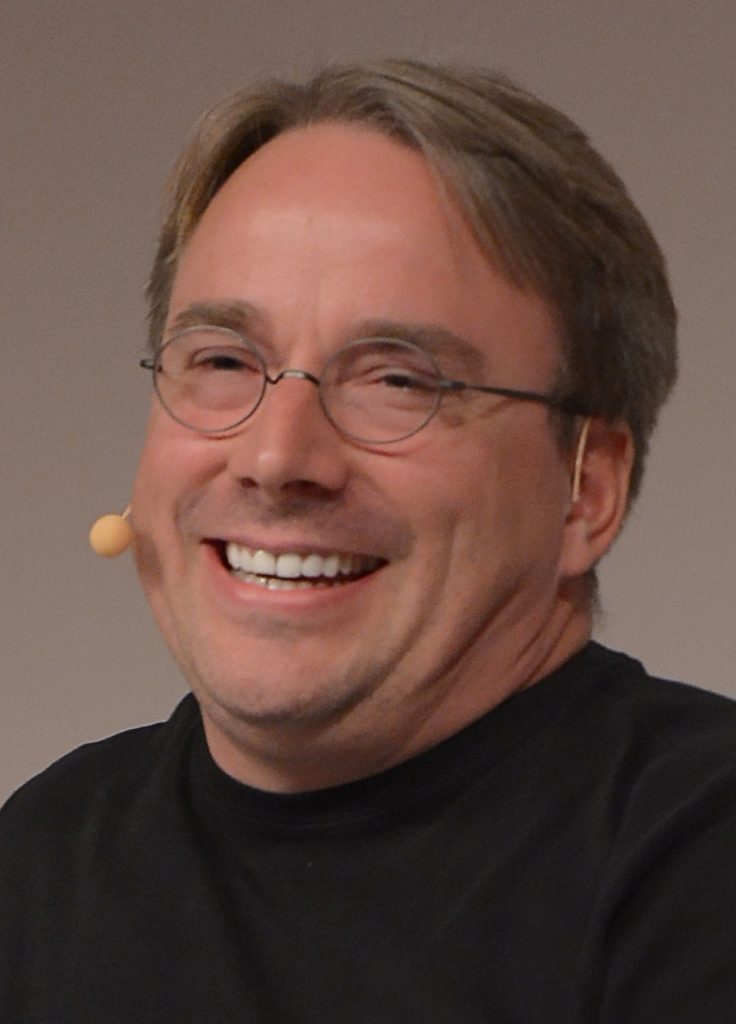
Portrait: Linus Torvalds at LinuxCon Europe 2014. Photograph by Krd, crop and rotation by Von Sprat. Wikimedia Commons, CC BY-SA 4.0.
Nominate a programmer
Nominate a programmer whose contribution deserves a place in the album. Lesser-known contributors are welcome. Describe the contribution and give us sources to check. Editors verify each submission before publication. Your email is optional and used for follow-up.


