
Sticker 005 · Adele Goldberg · Back to the album card · Leggi in italiano
When a program surprises you, you can read its code and imagine what happened. You can also inspect it while it runs, look inside its objects, and try a change. Adele Goldberg helped develop and explain Smalltalk, the Xerox PARC environment that made this second approach possible. Its guiding question matters beyond programming: what can we learn when a computer responds to our experiments?
From Xerox PARC to Smalltalk’s wider audience
Goldberg joined Xerox PARC in 1973 after completing a doctorate in information science. She worked with Alan Kay, Dan Ingalls and other colleagues on Smalltalk and on using computers for learning. In her Computer History Museum oral history, she describes the work of teaching objects and message sending to people who were unfamiliar with them. Her archived papers preserve course materials, manuals, demonstrations and records of the system’s development.
Goldberg helped develop the interactive environment and made it easier for people outside the lab to learn. In 1983 she and David Robson published Smalltalk-80: The Language and Its Implementation, often called the Blue Book, covering the language, its classes and its virtual machine. The ACM’s 1987 Software System Award for Smalltalk went jointly to Goldberg, Kay and Ingalls. The shared award reflects the project’s collaborative development. Goldberg went on to help found ParcPlace Systems, which brought Smalltalk tools and training to professional users.
Objects, messages and a way to see what is happening
In Smalltalk a number or a collection is an object. To ask a collection to add an item, you send it a message. Its class describes how objects of that kind behave. This lets programmers change how a collection stores its items internally without editing every part of the program that asks how many items it holds.
Smalltalk also stood out for its tools. The class browser let you find methods and read their source. An inspector exposed the state of objects and a debugger let you follow execution. In Smalltalk-80, the virtual machine’s image stores objects and system state, making it possible to resume work in an environment that already contains your work. The practical lesson is that exposing program state makes it easier to test an explanation when something goes wrong.
The Dynabook and learning by making
In Personal Dynamic Media (1977), Kay and Goldberg described the Dynabook, an imagined portable personal computer for writing, drawing, simulation and programming. Their demonstrations ran on research prototypes. A learner could build a representation, run it and change it when the result challenged an assumption. The educational idea still travels well: an exercise can teach more when you can see the consequences of a choice.
A Smalltalk example and the archived source code
The Computer History Museum’s Xerox Alto archive holds historical versions of Smalltalk. The records include a 1983 Xerox commercial licence agreement, and the Blue Book carries a Xerox copyright notice. Public access to an archive does not by itself grant permission to republish its contents. I could not verify an excerpt with both individual attribution to Goldberg and compatible reuse terms. The lines below are an original teaching example, with no attribution to Goldberg or Xerox PARC.
| letture |
letture := OrderedCollection new.
letture add: 12.
letture add: 18.
letture size
The first line declares a variable, whose name means “reads”. The new message asks the class to create a collection. The add: messages give the collection values to store. The final size message returns 2. Change one of the values and the result stays the same, because you are counting items.
What carried over into later tools and free software
Many modern development tools carry forward the idea that you should be able to explore a running program. In the Smalltalk family, one documented successor is Squeak, described in 1997 by Dan Ingalls and colleagues. Its virtual machine was written in Smalltalk and could itself be studied and changed. That work belongs to a later team. Goldberg’s contribution shows why documentation and tools for exploring code matter when you want other people to learn, participate and improve a system.
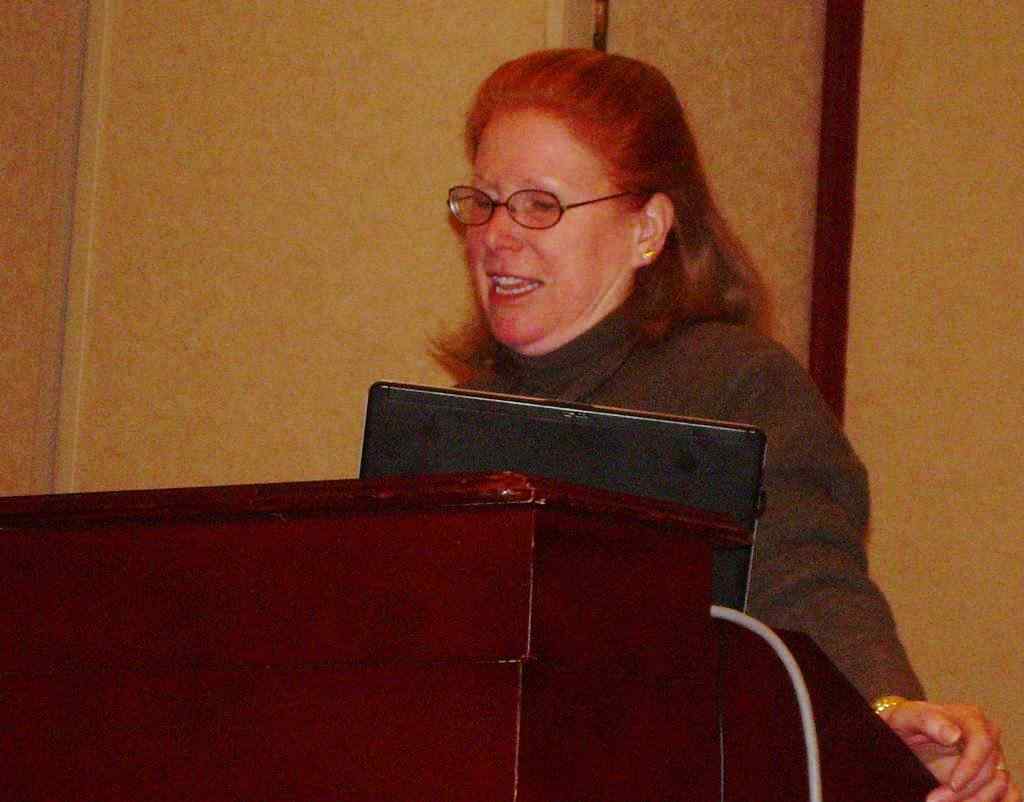
Portrait: Adele Goldberg at PyCon 2007, Terry Hancock, CC BY-SA 2.5, Wikimedia Commons.
Nominate a programmer
Know a programmer whose work deserves a place in the album, whether widely recognised or overlooked? Tell us what they contributed and where we can verify it. Editors review every nomination before publication. Your email is optional and is used only if we need to follow up.


