Leggi l’articolo in italiano su eccellenze.org.
Sticker 001 · Outstanding Programmers Album. Open Ken Thompson’s sticker · Browse the complete album.
Ken Thompson is a co-creator of Unix and a foundational figure in the history of programming languages and operating systems. His career connects B, Plan 9, UTF-8 and Go: different ideas linked by the search for tools that make other software easier to build.
Knowing a programmer means more than collecting product names. What problem did they face, what solution did they introduce, and what can we learn from their work? This first album story turns a sticker into an entry point to software culture.
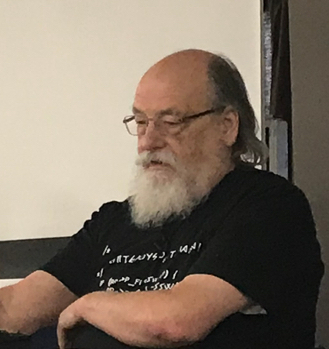
Photo: A.C.Diller, CC BY-SA 4.0, via Wikimedia Commons.
Who is Ken Thompson, and why sticker 001?
Born in New Orleans in 1943, Thompson joined Bell Labs in 1966. In 1969 he began Unix; work with Dennis Ritchie and other colleagues would lead to an influential family of systems and ideas. Thompson and Ritchie jointly received the 1983 Turing Award. Sources: Bell Labs archival biography and Computer History Museum.
Number 001 is not a score or a claim that he was history’s first programmer. It is the album’s editorial starting point. His story illustrates a crucial transition: from building a system to creating opportunities for the people who follow.
Unix: building an environment where others can work
Unix emerged at Bell Labs in the late 1960s. Thompson and Ritchie were central contributors within a research group. The laboratory’s account describes a project shaped by practical needs, experimentation and collaboration, rather than a finished product appearing at once. Bell Labs’ history of Unix.
For a non-programmer, an operating system can be compared to the organisation of a workshop: it assigns resources, provides tools and lets people work without rebuilding the environment each time. Good organisation is valuable partly because of what it allows others to do.
This offers a way to read Thompson’s contribution: not merely a solution that finishes one task, but an environment from which new tools can emerge. The lesson applies beyond computing: a useful method expands its users’ possibilities.
B and Dennis Ritchie: getting attribution right
In Users’ Reference to B, dated January 7, 1972, Thompson credits B’s design and implementation to himself and Dennis Ritchie. B descended from BCPL and preceded C. Saying Thompson “invented C” would be wrong: Ritchie’s role in C is central. Sources: the B manual and Ritchie’s history of C.
The album therefore distinguishes creators, co-creators and communities. Recognising a contribution does not require erasing neighbouring ones. Following the transition between languages shows how ideas are reused, corrected and transformed.
Authentic code from Thompson’s manual
These three lines come from the printn example in section 9.1 of Thompson’s manual. Internal comments are omitted. This is an excerpt, not a complete program or modern C:
if(a=n/b)
    printn(a, b);
putchar(n%b + '0');
The function writes a number’s digits. Division prepares the preceding part; recursion processes it; the remainder identifies the final digit. With 123 in base ten, output progresses to 1, then 2, then 3. a=n/b performs an assignment, not an equality test.
This is a brief documentary excerpt, not AI-reconstructed historical code or a licence grant for the whole manual. Read the complete function and context in section 9.1.
Plan 9 and UTF-8: continuing to experiment
Thompson was an original Plan 9 designer with Rob Pike, Dave Presotto and Phil Winterbottom. The system explored ways of organising resources and services. Its history includes UTF-8 adoption; Thompson and Pike played decisive roles in developing and implementing that encoding in 1992. Sources: the Plan 9 overview and project’s historical FAQ.
An encoding is an agreement for representing characters through numbers. For an Italian reader, that includes accented letters; for an international community, many writing systems. Behind apparently ordinary text on a screen is a technical agreement that lets programs interpret it.
The educational lesson is to notice invisible infrastructure: a small shared convention can help tools built by distant people work together. Recognising a specific contribution does not require assigning the entire history of Unicode to one person.
Go: another language built together
Go’s official documentation identifies Robert Griesemer, Rob Pike and Ken Thompson as the initial designers in September 2007. Thompson began exploring a compiler in January 2008; Go became a public open source project in November 2009. Many others helped it grow. Go history in the official FAQ.
A career can be understood as a sequence of questions, rather than a single achievement to repeat. For someone learning programming, this invites a study of problems and trade-offs: why create a tool, and what should it simplify?
Trusting Trust: asking what produces the software
In Reflections on Trusting Trust, published in 1984, Thompson demonstrated why examining a program’s source alone cannot guarantee trust in its production: the tools that turn it into an executable also matter. Read the original paper.
For an ordinary user, the lesson is not to stop using software, but to avoid automatic trust and absolute guarantees. Asking where software comes from and how it is checked is more useful than trusting a familiar name alone. This is an accessible reading of the issue, not a verdict on a particular product.
How does Ken Thompson relate to free software?
Thompson belongs to the ecosystem’s technical roots, but historical Unix must not be confused with GNU or the Linux kernel. FreeBSD documentation explains distinctions involving AT&T Unix and BSD development. The 1983 GNU announcement concerns a separate project initiated by Richard Stallman.
Not every ancestor of free software began as free software, and not every technical contribution is a political statement. The album recognises documented impact while distinguishing licences, periods and projects. Understanding today’s tools requires attention both to technical ideas and to the conditions that permit reuse.
Three lessons to take from his work
Build foundations. When solving a problem, ask whether you are also making a useful starting point for the next one. A reusable solution can help people you will never meet.
Embrace collaboration. Distinguishing contributions teaches more than building a lone-hero narrative. In your own projects, preserve contributors’ names, sources and important decisions.
Question the tools. Look beyond the result and ask which steps produced it. Even non-technical users can learn to ask better questions.
Frequently asked questions about Ken Thompson
Did Ken Thompson create Unix alone?
He started development and was a principal creator; Unix grew through Ritchie and many other collaborators.
Did he invent C?
No. He worked on B with Ritchie; C is associated primarily with Dennis Ritchie’s work.
Can I paste this code into a C compiler?
Not as a complete program. It is a historical B excerpt to read in the context of the 1972 manual.
Which sticker comes next?
Number 002, Dennis Ritchie. The series follows album numbering and links each card to its full story.
Nominate an outstanding programmer, famous or otherwise
Do you know someone who improved free software, tools, libraries, accessibility or technical documentation through a concrete contribution? Fame is not required. Provide their name, project, contribution and at least one checkable source. You can also suggest a correction to this article.
Suggestions are reviewed by the editor before inclusion. Your name and email are optional and used only for follow-up; do not include sensitive information. Contact details are not intended for publication.


Return to sticker 001 · Explore every sticker.
“One sticker, one story” series · Card 001 · November 18, 2026. The lessons are educational interpretations of the work, not personality assessments.