
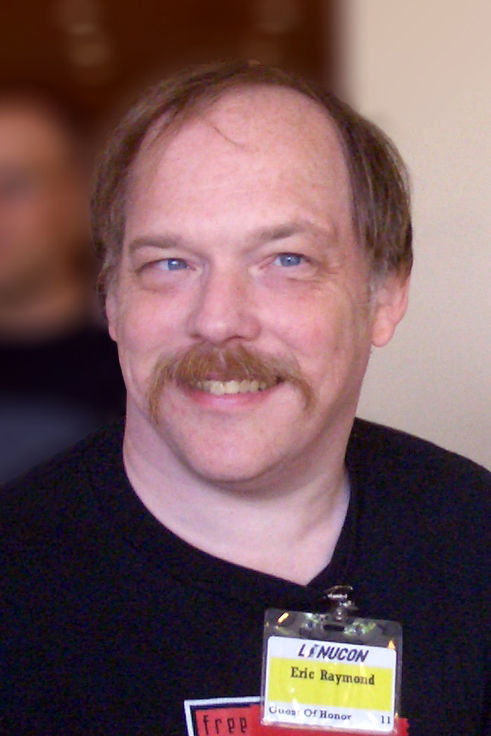
Sticker 011 · Back to Eric S. Raymond’s sticker · Leggi la versione italiana
In 1997 Eric S. Raymond used an email tool, fetchmail, to explain how users could help improve the software they relied on. The result was The Cathedral and the Bazaar, an essay that gave names to two ways of organising software development. One practical idea was to let people try versions early so they could show developers exactly where a program failed. Raymond’s essay, September 1997 version (PDF).
Fetchmail, from Carl Harris’s program to public releases
In the 1990s it was common to leave messages on a mail server and connect periodically to collect them. A program like fetchmail retrieved messages and handed them to the local mail system, where the user’s other programs could find them. POP and IMAP are two protocols a program can use to access mail on a server.
The starting point was popclient, written by Carl Harris. Raymond took over maintenance in 1996, added IMAP support and renamed the project fetchmail. A new team led by Rob Funk, Graham Wilson and Matthias Andree took over in 2004. Fetchmail’s history spans several generations of contributors and maintainers. Official Fetchmail site and maintainer history.
What the cathedral and the bazaar mean
Raymond’s cathedral describes a style in which a small group does much of the work before the public can try it. In the bazaar, more frequent releases let people with different setups, data and needs catch problems the original team might miss. Linux suggested the model to Raymond, and fetchmail gave him a project on which to try it. The 1997 essay (PDF).
Imagine a failure that only shows up with one mail server. One user can report the conditions that trigger it, another can recognise the problem in the code, and a maintainer can review the fix. This is how collaboration can make a difference. The outcome also depends on reproducible reports, careful review and the time maintainers can give a project.
An authentic excerpt from the ascii utility
The ascii utility looks up the numbers and names assigned to ASCII characters. This original excerpt comes from the btoa function in ascii.c, version 3.18. The loop reads the least significant bit, writes the character 1 or 0, then divides the integer by two to move on to the next bit. By writing from right to left, the function builds the binary representation in the order we read it. The version 3.18 archive includes the source and its COPYING file. Eric S. Raymond’s ascii repository · Version 3.18 source in the Debian archive.
    do {
	*--rp = (char)('0' + (val & 1)); /* Is '1' == '0' + 1 in EBCDIC? */
       val /= 2;
    } while
	(val != 0 && rp > rep);
Excerpt from ascii.c by Eric S. Raymond, under the BSD-2-Clause terms below.
BSD-2-Clause licence for the excerpt
BSD LICENSE

Copyright (c) 2015, Eric S. Raymond
All rights reserved.

Redistribution and use in source and binary forms, with or without
modification, are permitted provided that the following conditions are
met:

1. Redistributions of source code must retain the above copyright
notice, this list of conditions and the following disclaimer.

2. Redistributions in binary form must reproduce the above copyright
notice, this list of conditions and the following disclaimer in the
documentation and/or other materials provided with the distribution.

THIS SOFTWARE IS PROVIDED BY THE COPYRIGHT HOLDERS AND CONTRIBUTORS
"AS IS" AND ANY EXPRESS OR IMPLIED WARRANTIES, INCLUDING, BUT NOT
LIMITED TO, THE IMPLIED WARRANTIES OF MERCHANTABILITY AND FITNESS FOR
A PARTICULAR PURPOSE ARE DISCLAIMED. IN NO EVENT SHALL THE COPYRIGHT
HOLDER OR CONTRIBUTORS BE LIABLE FOR ANY DIRECT, INDIRECT, INCIDENTAL,
SPECIAL, EXEMPLARY, OR CONSEQUENTIAL DAMAGES (INCLUDING, BUT NOT
LIMITED TO, PROCUREMENT OF SUBSTITUTE GOODS OR SERVICES; LOSS OF USE,
DATA, OR PROFITS; OR BUSINESS INTERRUPTION) HOWEVER CAUSED AND ON ANY
THEORY OF LIABILITY, WHETHER IN CONTRACT, STRICT LIABILITY, OR TORT
(INCLUDING NEGLIGENCE OR OTHERWISE) ARISING IN ANY WAY OUT OF THE USE
OF THIS SOFTWARE, EVEN IF ADVISED OF THE POSSIBILITY OF SUCH DAMAGE.
From open development to the Open Source Initiative
In February 1998 Raymond and Bruce Perens founded the Open Source Initiative. The Debian community’s guidelines provided the basis for the Open Source Definition. The OSI’s work on licensing and Raymond’s essay address two parts of collaboration: licences grant rights, and the way a team works determines how easy it is to exercise them and contribute. Official history of the Open Source Initiative.
Portrait from a photo by jerone2, cropped and retouched by Bilby. Wikimedia Commons · CC BY-SA 2.0.
Nominate a programmer for the album
Who has made an outstanding contribution to software? We welcome nominations for well-known and lesser-known programmers. Give us a name, a specific project or contribution and sources we can check. An email address is optional and helps if we need clarification. The editors review each submission before deciding whether to publish it.


